Monday, 15 November 2010

27, THE CLOCK by CHRISTIAN MARCLAY


WHITE CUBE GALLERY, MASONS' YARD, LONDON 15.11.10
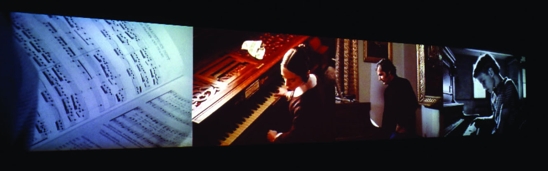


I first saw Marclay’s work in 2002 as part of Mike Ricketts’ Art Now course at Tate Modern. Video Quartet is a collage of synchronised film clips transferred to colour video and audio track on four huge screens standing side by side. Marclay uses either the original music/voice/sound effects or inserts other found sound, such as car horns, tapping feet and glasses being filled with water. It begins quietly with tuning up, moves into a crescendo, then cacophony and finally calm. The music is said to suggest 'the poetry & chaos of contemporary life, personal & anonymous, free & suppressed’. When I went back later people were having a great time dancing in the gallery.
This month Marclay has been back in town.  The White Cube Gallery - http://www.whitecube.com/artists/marclay/ - which lurks in Mason’s Yard, Piccadilly, is the sort of building which amplifies whatever state-of-mind you bring to it. On good days it’s as fresh, exhilarating and breath-taking as an ocean gale.  You reel around as if on a deck awash with new ideas.  Today it’s just a square of  cold steel, concrete and glass stripped of colour, sharp edges and corners, bare walls and lots of steps to climb and re-climb (lift not working), plus reception staff  who, for reasons known only to themselves,  have hit on the device of pretending no one’s there.

Down, down into the basement and a pitch black cinema. A charming young man with a torch offers to find me a seat.  I can no more call him an ‘usher’ - with its hint of trays loaded with choc ice cream and pop corn  - then I can designate  the large comfy settees scattered randomly over the floor as ‘cinema seats’, for they do not tip up and are neither  scanty nor hard as a rock.

There is no starting time for Marclay’s 24 hour video. 'The Clock' is a collage of thousands of fragments of cinema at moments when time is expressed or a character interacts with a clock, watch or anything telling the time. They are woven together so that they flow in real time: I know I arrived at 10am exactly because it said so on the screen. But swiftly it’s a few seconds past 10 and I’m caught up in a vast current of narratives, settings and moods within the space of a few minutes. Time and place unravel all over the screen: b/w and colour, film noir and Tony Hancock; tenderness and cruelty lie cheek by jowl. Some events are more  clock-dependent than others so heists, job interviews, funerals and kidnapping are more popular than ,say, childbirth, marriage proposals or heart attacks. It’s bracing stuff.

Normally I go to a cinema and consent to be transported by a narrative (or non-narrative) anywhere at any time: past, present or future. When I come out I may be surprised that it’s dark or raining, as if I had expected my real time to be suspended. With The Clock the position is reversed. The viewer’s time is rooted in the here and now and is as predictable as ever, but it is stuffed full of countless fictional events -  punctuated by stabs of personal memories of films and actors and settings already known - which appear to be going on while she is sitting in the cinema. As I said it’s bracing stuff.

26. MIRE AND CLAY by MUNGO McCOSH

ABBOTT & HOLDER GALLERY, lONDON 15.11.10
 
There’s nothing stealthy or sleazy about private viewings, simply the chance to see art with a free glass of wine the day before the exhibition is open to everyone. Agreed the wine might improve the chances of a sale – I recall at the same gallery in the 90s sitting in a roof garden when the summer sale was on, and buying The Upside Down Chair 1966  by Pamela Izzard, a large oil painting all 60s oranges and blues which has hung in my various kitchens ever since and is loved more and more each day.

I arrive at the Abbott and Holder Gallery at noon, the very minute the show is due to open, and climb several flights of stairs. I know of Mungo McCosh as an illustrator - Out of the Woods  and An Alphabet of Aunts. (I later discovered he’d painted the rood screen in the Crimean Memorial Church in Instanbul and in 2007 was an embedded artist with the Argyll and Sutherland Regiment in Basra - but those I am not likely to ever visit). So I’m surprised to walk straight into a room full of beautiful linocuts. Then it happens. This picture jumps out at me. I’m a sitting target, having once built an installation of (empty) golden syrup tins on the window sill when  I moved into my new office, to remind me of life outside.

The artist himself greets me. The idea for Mire and Clay came from a conversation with a cousin in the kitchen making biscuits. When asked, she said she’d like a painting of a hungry lion. Here it is. I know almost nothing about linocuts and when he began to describe what goes into making such a beautiful picture I became dizzy at the thought of so many processes.

Why is it called Mire and Clay, I ask? Tate and Lyle tins have a text which runs along the lower half of the white egg-shape encircling the lion. It’s from the Old Testament:
 ‘Out of the strong came forth sweetness, (Judges chapter 14, v 14) and is indelibly fixed in the minds of countless small children who ask at the breakfast table what on earth the lion thinks he’s doing..
But here we have a verse from the Psalms, which in a modern translation runs like this:
 ‘He lifted me out of the pit of despair, out of the mud and the mire. He set my feet on solid ground and steadied me as I walked along’. ( Psalm 40 v 2).
‘Clay’ instead of ‘mud’ comes from the King James translation.

‘My’ picture is number 2 of an edition of 30. Why did I buy it? Because it is a beautiful work of art; because I could (just) afford it; because it’s witty; because it reminds me of warmth and food and being cared for; because it glows as brightly as the Bible text which speaks of quiet and confident and hopeful footsteps.  


Wednesday, 10 November 2010

25. CHEWING GUM MINIATURE MASTERPIECES by BEN WILSON

LONDON PAVEMENTS  10.11.10


http://www.bbc.co.uk/news/entertainment-arts-11677462

I'm cheating here because I haven't seen this art, only pictures of it on the above website. When I go out I try to keep my eyes down, but no luck so far.

Ben Wilson paints miniature pictures on chewing gum stuck firmly to the pavement, having first prepared his ‘canvas’ to make it more durable by applying heat and lacquer.  Old gum is best having no moisture and presenting a good flat surface. Each one may take from a couple of hours to days to paint. Some are abstract, some are representational and may refer to people or places in the neighbourhood. They belong to no one and there’s no plaque nearby to tell you what they stand for. The more people are creative in their environment, Wilson believes, the more they’ll feel responsibility for it.

On screen the pictures look like bright little cameos which should lift the hearts on any passerby. Unless of course they feel that making something special out of second hand chewing gum is disgusting. There’s a question as to whether he can be charged with criminal damage too, though, as he reasonably points out, the damage has already been done by the person who spat out the gum.  

The Royal Society of Chemistry is exploring the possibility of commissioning him to paint depictions of each of the 118 known elements.


http://www.bbc.co.uk/news/entertainment-arts-11677462


Monday, 8 November 2010

24. SUBMISSION by NINA FOWLER

 pencil, 47.5 x 62.5 cm
                                                 JERWOOD SPACE, LONDON 8.11.10
 
This drawing was shortlisted  for this year’s Jerwood Drawing Prize (which goes on tour in 2011). One critic wrote ‘Nina Fowler has produced a beautiful drawing of three women, Submission, in sharply defined pencil relief. What is their connection? We shall never know why they look so yearning’.

I can well believe there are cultural references which escape me every day but at face value this one looks simple: Rudolph Valentine (1895 – 1926), Clark Gable (1901 – 1960), and Marlon Brando (1924-2004) are film idols who span the 20th century when a new sort of fame became available to performers through cinema. It crossed continents and lasted tens of years, not tens of months. When Valentino died aged 31 there were riots and hysterical collapses and wild rumours about secret outside malevolence, something not unknown in this country not so long ago. The artist herself has produced Valentino’s Funeral, a collection of pencil and graphite drawings of the movie gods and goddesses of the Hollywood age who attended.

So here we have three beautiful portraits - like frames from a film - of women filled with yearning for their pop idol, a yearning which can never be satisfied. On the left is blind tearful adoration, a woman rising up to assure us that she is intends to be left comfortless.  On the right an enigmatic woman lies on her belly, waiting.  The woman at the centre looks back into the picture, warm and safe, passive and patient. While a camera gives us flesh and blood and oil gives us permanence, a mere pencil makes these portraits ethereal, full of space. Three Titanias, perhaps?

These women do not have their feet on the ground.  They are all lying on some sort of bed or couch which are things that in real life most people use for most of the time as a place for sleeping or talking. But in art you rarely get beds without sexual intent: if that’s absent the subject is likely to be lying there wanly dying or just plain dead. Women lying on beds or the floor have been widely used in advertising too.

So sexual intent is registered but why is the title Submission? Fowler is after something stronger than vague girlish longings which easily vanish. These women cannot free themselves from the allure. They adore, they empty themselves, they are glad to be passive victims. In real life submission is not pretty or charming or even fun. It’s deeply serious. It has financial and political implications. In the wrong hands it can have terrible consequences. 

What are these pretty girls doing? Will anyone draw them in 10 years’ time?


Friday, 5 November 2010

23. TRACEY EMIN AS FRIDA KAHLO by MARY McCARTNEY

© Mary McCartney
NATIONAL PORTRAIT GALLERY 5.11.10

Three women are present in this picture: the subject Tracey Emin; the woman she’s ‘impersonating’ the Mexican artist Frida Kahlo; and Mary McCartney the photographer. It’s part of the display of photographs by Mary McCartney called FROM WHERE I STAND’ which is at the National Portrait Gallery until 13.2.11. 
 McCartney’s interest in photography began when assisting her mother, Linda McCartney. She became a professional photographer in 1995. FROM WHERE I STAND is a collection from her archive of informal portraits of old friends, family and famous people.

You could be forgiven for thinking that we have enough portraits of celebrities to be going on with...and yet what a multi-faceted gem this is.

Frida Kahlo, a Mexican artist who lived in the first half of the last century, was once described as ‘a ribbon around a bomb’, which I think is a pretty good summing up of this portrait of Tracey Emin. Here she is, like Kahlo all flowers and frills, bejewelled, in virginal white, lying in bed. Yet we know both of them as artists of exceptional anger, honesty and vitality, untouched by self pity or humility.
 
Freda Kahlo
In both cases their art displayed their life history. Emin became famous overnight with her unmade bed at Tate Britain; her tent entitled Everyone I Have Ever Slept With 1963–1995 ; and her moving video ‘Why I never became a Dancer’ . She uses text, paintings, embroidery, video and installations to re create her past. Sometimes her work is funny, often tragic. Kahlo’s paintings include terrible depictions of the pain endured from her teens onward after a traffic accident which broke her body. The medical help of the time tortured her further with surgical interventions, corsets and mechanical "stretching" systems.  Living in a deeply macho world with her philandering husband, Diego Rivera, a man of great fame and ferocious artistic energy, didn’t help either.
McCartney’s portrait magically conjures up these two women’s  uncompromising depiction of what they experience as women. A former Bishop of Bristol used to talk of ‘telling it slant’ when it came to important things, because straightforward words and pictures fall short. Emin’s face is wary, like a mask. Her neck seems tense. She gives nothing away. So we look to the setting, the artefacts for clues.  Kahlo used teardrops, thorns, nails and arterial red ribbons with psychological intent.This sort of work made more sense to me when I heard a Tate lecturer suggest that Emin’s unmade bed was the latest (visual) contribution to a long European tradition of confessional writing by young women. Some people have suggested that such self-portraits could be compared to religious icons. 

 http://www.lindamccartney.com
http://www.npg.org.uk
http://www.fkahlo.com

Tuesday, 2 November 2010

22. NORTHERLY MIGRATION by DAVID DAVIES

JERWOOD SPACE 2.11.10

The Jerwood Drawing Prize, sponsored by Parker Harris, is the largest and longest running annual open exhibition for drawing in the UK, open to anyone resident or domiciled here. I first call in to see this year’s prize winners and shortlist too early, before the exhibition has been properly hung. Any excuse for visiting the Jerwood Space. I have a cup of tea. An empty cafe: 28 chic white chairs standing guard in groups of 4 round immaculate tables. It’s Friday at 3.30 – why isn’t everyone partying ready for the weekend? The floor is black, the counter is black. Only chrome glistens. My white cup of tea comes in an asymmetric saucer, which is a good device for making you notice it, as it easily spills. Outside on the terrace with its white floor, white chairs and white bunting, a solitary man is eating a pink ice cream. Pity he didn’t choose vanilla. 

2 ink pencil and charcoal on Arches Velin crème 65.8x.85.5

When I call back later  Northerly Migration  catches my attention. A small image cannot convey the subtlety of this beautiful drawing. What look like slightly powdery tadpoles at first glance are all travelling in the same direction to the top of the sheet of paper, Immediately there is a glimpse of a story - where did they come from and what happens when they get to the top? I find I care about these peaceful travellers, heading off in pairs or groups or making a solitary journey. Sometimes the line of the mesh shows through their bodies giving the little creatures an eerie transparency. And anyhow, they’re us really, aren’t they? 

What immediately springs to my mind is the 1983 film Koyaanisqatsi , with its haunting evocative score by Philip Glass. In the Hopi language the word Koyaanisqatsi means "crazy life, life out of balance, a state of life that calls for another way of living".  It was the first time I’d seen aerial views – which is what Davies’ drawing is – of multitudes of human beings,  speeded up, slow motion,  in cars, on escalators,  Like the drawing, the film is speech-less.Godfrey Reggio, the Director, justifies the lack of dialogue:  ‘it's not for lack of love of the language that (this) film has no words. It's because, from my point of view, our language is in a state of vast humiliation’. 

This drawing has a calm, mesmerising and thought-provoking quality, as well as reminding us that drawing is still alive and well doing what no other art form can manage.
 ‘I need to be as surprised by what I create as much as anyone else that may see it. It's that 'internal travel' experience of not knowing what's around the next corner that keeps me enthralled by the whole process of making art’.DAVID DAVIES

Monday, 1 November 2010

21. (UNTITLED) POSTER PAINTINGS 2008 by KLARA LIDÉN


SERPENTINE GALLERY 1.11.10
 
Where is the art in this?
Nothing in the room except about 20 'poster paintings' round the wall, each one comprising perhaps 10 or 12 layers of old and battered posters piled on top of one another, the top layer completely message-free.  The caption says that they are found posters, topped by a blank sheet painted white, and held stiffly together by wheat paste. I find I want to pick at the stiff curled and bent edges of the posters which tease me with a glimpse of scraps of colour and writing. What have I missed? A circus? A film? A Two-For-One ticket offer?

Why did Liden do it? She’s been described as a space hacker. She is a Swedish artist and has done this in real life too by pasting blank paper over advertising hoardings in Copenhagen. She ‘rethinks the places we inhabit and builds spaces that deviate from their normal functions’.  By breaking into our patterned expectations , our ‘default’ position, and then creating ‘nothing’ does she shows us what is missing? A blank space might leave room for thoughts and feelings we normally keep at arm’s length.  

An axe tied to a piece of string hangs from the pulley above the door into another room.  Here Unheimlich Manover ‘explores the psychological and physical space we inhabit’. It consists of everything in her apartment : cratesbookslaptophammockjeansflaskduffelbagtinsfridge, squashed together on metal shelves slung on scaffolding   All is sprayed black and the paint lightly splashes  the walls beside it. It’s the black of the negative of a photograph. Or it could be the charred remains of a fire.

Liden  says her aim is ‘to divert materials or spaces from their prescribed functions, inventing ways of making these things improper again’. She makes me think of Michael Landy with his immensely powerful installation Break Down , when he hired the redundant and empty C & A store in Oxford Street in 2001 for a few weeks in order to destroy everything he owned. Ten workers filled and refilled a conveyor belt with his stuff, reducing each item to its basic materials and then shredding it. Mass production in reverse.  They included the irreplaceable like family documents and valuable paintings, his own as well as gifts from friends.  At the end all that was left were bags of rubbish, none of which were sold or exhibited. As we watched mesmerised, above our heads slogans left by C & A urged us to spend and be happy.

Is Liden’s work antisocial and chaotic or is she ‘purposeful, (disrupting) our shared and accepted social norms with a focused radical energy? And Michael Landy?