Wednesday, 12 January 2011

44. UNTITLED by GIDEON RUBIN 2010

oil on linen 35cmx30cm © Rubin Gideon
 TENNANT GALLERY, ROYAL ACADEMY, LONDON
12.1.11

Alas, I only saw this arresting picture on the penultimate day of an extraordinarily interesting free exhibition at the new Tennant Gallery at the Royal Academy. The show was called No New Thing Under The Sun, a quotation from the first chapter of the Biblical book of Ecclesiastes. 
The curator Gabriel Coxhead put together about 50 works spanning the last 500 years, showing historical pieces from the Royal Academy's Collection alongside works by contemporary artists. His intention was to mount ‘a show about religious themes that isn't necessarily religious, at a time when ideas are polarised – fundamentalist pronouncements of faith on the one hand and extreme rationalist declarations on the other....It feels as if there's no space in which religious ideas can be considered for their mythical and spiritual significance outside of this increasingly fraught debate about whether or not God exists’.

The result is an exhibition which offers an astonishing collection of works ‘from the cynical to the celebratory, from the rational to the magical, from the astonishingly gruesome to the tenderly poignant’. It does what it claims to do: to offer a chance to pause, reflect and connect with ‘a sense of joy at being alive in the here and now’.

Rubon’s work originates from an anonymous photo he found in an old album. We know that photographs have a mystical potency. We tear them up - or burn them - in rage or grief. Alternatively they can nestle in elaborate frames or be slipped between the leaves of a book and loved for years. They are used to sell more or less anything. Founder’s photographs are displayed and honoured to add gravitas to an institution. Sometimes they’re defaced or obliterated by totalitarian regimes.

So it’s a shock to find an image of a girl we know nothing about, her own distinctive features having been wiped out. She is Everywoman. The Unknown Soldier in her tomb. The living breathing laughing girl she once was is unreachable. The hands which cut her hair are gone, as are the people who stitched her white blouse and tunic. It’s outrageous, a hideous disturbance of what we expect.

I began to think of my own family albums. Of a group photo of perhaps 60 people at a dance, only one of whom, now long dead, I recognise. Not only are their loves and lives, their ball gowns and sharp suits all gone but so has Queens Engineering Works, the powerful firm which employed them and others in Bedford for over a century. The place which designed ships which helped win World War Two is now the site of riverside flat.
Back to Ecclesiastes. What does the King James version of the Bible tell us? 
‘One generation passeth away, and another generation cometh; but the earth abideth for ever. The sun also riseth, and the sun goeth down, and hasteth to his place where he arose. The wind goeth toward the south and turnest about unto the north, it whirleth about continually. And the wind returneth again according to his circuits. All the rivers run into the sea; yet the sea is not full; unto the place from whence the rivers come, thither they return again....there is no new thing under the sun’.

www.gideonrubin.com

Saturday, 8 January 2011

43. SANCTUARY by GREGORY CREWDSON


WHITE CUBE, MASON'S YARD LONDON 8.1.11

Untitled (4) 'Sanctuary' 2009,  Framed: 72.4 x 89.5 cm   Pigmented inkjet print
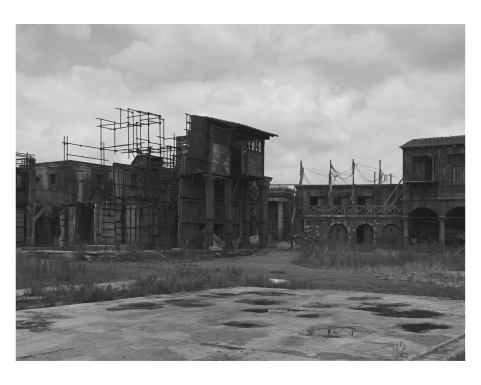
Gregory Crewdson works within a photographic tradition which 'combines the documentary style of William Eggleston and Walker Evans with the dream-like vision of filmmakers such as Stephen Spielberg and David Lynch'. His method is filmic - he builds elaborate sets to take pictures freighted with extraordinary detail and narrative portent. What once fooled us into thinking we were looking at Imperial Rome, historical New York and medieval Italy is now a series of abandoned film sets in Rome, which Crewdson has turned into a set of 41 pigmented inkjet prints.

 Actors and crew members are long gone. What should be a timeless ruin is held together by scaffolding. A street of wooden buildings is punctuated by gaping holes. And the only invaders are trees, vines and bushes, frothy patches which pit themselves against the stark geometry of the buildings. Indeed one particular spiky weed stands upright with military precision shoulder to shoulder wherever it can get a foothold, between cobbles, inside rooms and along kerbs. The prints when framed are an approachable, domestic size.

I usually can’t resist pictures of absent presences, places of abandonment: a meal table after a dinner party, clothes tossed on a bedroom chair, an empty pair of boots by the back door. Crewdson says that he wants the project to be a love letter to the history of classical documentary photography. I think I fail to appreciate Crewdson’s work as much as it deserves. I have, alas, seen far too few films in my life, and lack the tools to decode the references.

Thursday, 6 January 2011

42. AIRS ABOVE THE GROUND by SALLA TYKKÄ


HAYWARD GALLERY 6.1.11

Although I've visited the Hayward Gallery many times, I've never noticed the Project Space up a short flight of stairs on the left, designed to mount a changing programme of single installations and small exhibitions of works by emerging artists. And it’s free. 

Airs Above the Ground is the title of a new film by the Finnish artist Salla Tykkä. It features Lipizzaner horses - the oldest pedigree breed in Europe – where foals, like cygnets, are born dark and gradually turn lighter until, like swans, they are entirely white. The stallions are bred to perform haute école or high school classical dressage, including stylised jumps and poses known as ‘airs above the ground’. As you watch the dramatic ‘dance’ it’s hard not to think of ballet and Swan Lake, despite the fact that the subjects of the film are huge, muscular  horses. As well as having the Agnus Dei from Bach's Mass in B Minor on the soundtrack, we also hear the forcing of the horses' breath into their lungs and  the stamping of their hooves on the earth.

            At one level we are watching a beautiful short film. Footage includes young foals running through what looks like wild woodland as well as adult stallions completing gravity-defying feats of dressage. At first I was distracted by the fact that the film was shown not in a continuous flow of movement but in very swift jumps from frame to frame. The advantage is that for one frozen moment your eyes see the ‘impossible’ – a large stallion jumping straight up until it is poised and hanging in the air in a pose of exquisite beauty.

            In the accompanying notes Tykkä muses on her purpose in making the film. She talks of reading about Ruskin's belief that the beauty of nature can make people good. She’s challenging Ruskin. ‘Loving beauty can make people very intolerant’. Can the search for perfection even lead to fascism?  The film is challenging us to think about human control over nature. For aesthetic or economic reasons we have been manipulating many of the animals we love and care for -  dogs, cats, race horses - for centuries. Is the Lipizzaner an extreme example? What will genetic manipulation bring?

 Which made me think of what we (women especially) do to ourselves in pursuit of a culturally determined ‘perfection'. At an early age we learn to link good and beautiful versus ugly and bad.  We mutilate ourselves by wearing shoes which damage our bones, use dyes which damage our hair, risk death to get a tan and risk starvation to keep slim. 

P.S. Another discovery at the Haywood:  the Waterloo Sunset Pavilion, a 'drop in centre for children and old people and a space for viewing cartoons', which overlooks the Thames and is open during and between exhibitions - again all free.

Tuesday, 4 January 2011

41. PETE POSTLETHWAITE BY CHRISTOPHER THOMPSON

NATIONAL PORTRAIT GALLERY, LONDON 4.1.11

When I heard on the 1pm news bulletin yesterday that the actor Pete Postlethwaite had died, I went straight to the National Portrait Gallery to look at this painting. Unfortunately it wasn’t in its usual place, having been removed because extra wall space was needed for a temporary exhibition. But I  had this image on my files.

© The Artist 
The painting is in a black frame, and all we can see is an empty black background which could suggest a curtain, a padded black leather chair with its back towards us – and Pete. He’s wearing a black sweater with scraps of white shirt at his neck and elbows and looks not at us but out of the picture to his left. His lower half is obscured and, relaxed, his arms are crossed over the back of a chair. There appears to be a gold signet ring on the fourth finger of his right hand and a wedding ring on his left. There is no distraction: you are alone with this outstanding  actor.It’s a pose which quirkily reminds me of a famous picture of Christine Keeler astride a chair which I last saw at the Major Gallery in 2008.


It’s a beautiful, thoughtful, spare painting, relying on flesh tints against such a sombre background to make him alive and fully present with us. I first saw him in Bristol in the 1970s where he’d been at the Bristol Old Vic Theatre School, whose alumni include Miranda Richardson, Jeremy Irons, Daniel Day Lewis and Patrick Stewart. Twas heaven to be alive in Bristol and its theatre-going that decade. Seeing Postlethwaite romp in Guys and Dolls and Day Lewis tearing the stage apart in Class Enemy is not the sort of experience you easily forget. Today tributes are pouring in from around the world from people who knew him or  his work. As a political activist as well as an actor. For example he marched against the Iraq war.was a supporter of  the Make Poverty History campaign and was said to have influenced government policy on regeneration of mining areas (the film Brassed Off) and global warming (The Age of Stupid).

The Guardian has a fuller picture of this remarkable man's determination, confidence, commitment and genius.

http://www.npg.org.uk 
www.albemarlegallery.com/artists/christopher-thompson 


Monday, 3 January 2011

40. UNTITLED BY DAIS

LOWER MARSH, WATERLOO, LONDON 3.1.11


Below is a picture of people watching a painter at work, while at the same time, less than a mile away, a crowd behind a barrier was watching Ben Johnson (previous blog) in Room 1 at the National Gallery. But, despite the ladder and paint spray guns both men have in common, there the similarity ends.  Dais - which is how he likes to be known - is in a subway, close to Lower Marsh outside Waterloo station. My daughter and I had taken a short cut because she wanted to show me a mural she’d seen the week before.  


Johnson’s paintings, which take years to make and which sell well, last, but last week’s mural had gone. All that was left was a recently-painted black rectangle with just a few remnants of colour remaining. Had my daughter seen an ice sculpture or performance art, she’d have expected it to have disappeared. But somehow painting on walls suggests something a little longer lasting, with a whiff, say, of the Sistine chapel or Herculaneum and Pompeii? 
 But graffiti has a new sort of permanence, usually with no price attached. First there’s the group from the Far East who’re videoing the artist at work. Then there’s my picture of them filming the artist, to be shared on the internet. Dais was pleased to be photographed, I think. His name is distinctive but impersonal. I know nothing more about him. There are a number of sites in different parts of mainland Europe which crop up if you Google ‘dais’ and ‘graffiti’ together but I’ve no means of knowing if there is more than one artistic Dais in the world.

What’s more, I went on to photograph the people filming a man nearby who was miming a song for what must have been a promotional video. The film crew had driven a car into the subway and parked it by the singer. So, instead of the reverential hush surrounding Ben Johnson at the National Gallery, the tunnel was ablaze with music amplified inside and out by the car’s four wide- open doors. We were also within tens of yards of trains going in and out of Waterloo. Here was a tiny ecosystem: a music studio, a walkway, an art gallery - and a place where homeless people sleep at night.  


Friday, 31 December 2010

39. LOOKING BACK TO RICHMOND HOUSE by BEN JOHNSON

Detail from Ben Johnson, Preparatory drawing for 'Looking Back to Richmond House'', 2010, superimposed on the geometry of Canaletto's The Stonemason's Yard © Ben Johnson 2010. All Rights Reserved DACS

NATONAL GALLERY Glad you liked it. Would you like to share?

Facebook
Twitter

NATIONAL GALLERY, LONDON 31.12.10

There are just three paintings in Ben Johnson’s exhibition, Modern Perspectives, in Room 1 of the National Gallery. They are cityscapes of London, Zurich and Liverpool. Photographs taken from the rooftop of the gallery helped to shape the London panel, shown here. The geometry of the painting was also influenced by Canaletto’s Stonemason’s Yard  on display in a room nearby. Like Canaletto, Johnson manipulates the topography to create an ideal view. The cityscape is half real, half imagined.

A crowd of us stand quietly behind a barrier in this smallish room to watch Johnson and his assistants working, Each section is painted using an overlay of vinyl stencils which are cut out by a computer from drawings made by hand on the computer. The term for removing the stencils is 'weeding'. Although the preparation is a team effort, all the paint in his vast palette is mixed and applied by Johnson himself. As we watch he works away, drawing us in,  reminding us ‘that every work in the museum is the product of people getting their hands dirty and often the product of collaboration’.

I begin to feel restless. Watching an artist at work is absorbing, but how can I  get past the process and into the picture? ‘Stand in front of the painting’ Ben Johnson is quoted as saying, ’Approach the physical reality of paint on canvas with an open mind and a new subject should arise...a  subject or image should dissolve and be replaced with the reality of now – of being in the present moment using just paint and canvas as an object of concentration. The image is just an illusion. The experience of observing is a reality’. 

I can’t do that with work-in-progress because it’s too busy, so I turn away to the picture of Zurich hanging on a wall close by. The note says that the canvas took the artist and three assistants two years to complete. It’s a city I know and love, shown pure and true under a clear blue sky. It’s hyper–real, a term I first heard in 1993 when Philip Harris won the BP Portrait Award First Prize with his astonishing painting Two Figures in a Shallow Stream. Meticulous detail means that textures, surfaces, lighting. colours, all appear clearer and more distinct than in ‘reality’.
Nothing stirs in this Zurich. People, traffic, the changing shifts of weather are all absent and what is left is space, silence, stillness. I notice a 6-paned window half lit, half in shadow and feel the sheer pleasure of the warmth of the sun. A solid river Limmat, usually frisky, bisects the painting and flows into the lake.  Shimmering water it undoubtedly is but it is present, ‘there’, in a way which is difficult to describe.

            Johnson is quoted as saying his paintings are ‘an attempt to find that still point in the turning world TS Eliot searches for in the Four Quartets'. I think it's something most of us search for in our more reflective moments. 'The paintings are about orientation and grounding, about a certain contentment you feel in an exact place at an exact time under exact light'. 

www.nationalgallery.org.uk
 www.benjohnsonartist.com 

Tuesday, 28 December 2010

38. INEXTINGUISHABLE by ALBERT IRVIN

 GIMPEL FILS, LONDON 28.12.10

Merrion
 As I walk to Gimpel Fils the snow, which earlier had been floury and fluffy, has turned into pellets the size of pine nuts which settle on my faux fur coat. I see Irvin’s work every day because one of his prints, Merrion, lights up our living room.  When I met the artist some years ago at a Caroline Wiseman Gallery party, I asked him if Merrion was a Welsh name.
 ‘No, Irish,’ he said, ‘I named it after a Dublin Square I walked across every day when I had an exhibition at the Royal Hibernian Society and was living at Trinity College.’
A young man with a shaved head came up to us. He said he’d just bought one of Irvin’s paintings (not, like me, a mere print).  Irvin asked him ‘What do you do to keep the wolf from the door? ‘
 ‘I write software for banks'.
Irvin turned back to me, ‘As your husband is a man of the cloth, I can tell you a story I don’t often tell. There’s a Welsh clergy couple who are convinced I’m sent by God. I said I wouldn’t go that far, but they say ‘We love the energy and colour and beauty and vitality in your paintings. They remind us of what the world can really be like, what’s there if we have the eyes to see'.
Inextinguishable, acrylic on canvas. 214 x 305 cm  
A catalogue quotes  Henri Bergson's version: What was mobile and frozen in our perception is warmed and set in motion. Everything comes to life around us…we feel ourselves uplifted, carried away, borne along by it. We are more fully alive…’ .

 So I’m standing on a frosty morning in Gimpel Fils in Mayfair. There’s no one there. Even the office/reception is behind a split wall. But the place is a riot of energy. Spectacular paintings are exploding round the room on the pale walls, changing, becoming, moving, growing . Irvin gave up painting big canvases some time ago but here he is back again. It looks like the work of an extraordinary young energetic artist who is truly in love with painting. He has no assistant and has to rely on his own muscle power. It took three months to paint.
Back at the party I went to a few years ago, the gallery owner joined us and announced to Irvin that in New York she could sell anything done by the YBAs (Young British Artists).She smiled and said ‘Shall I turn you into one?’
Irvin is eighty eight years old, but the spirit within him is truly inextinguishable.

www.albert-irvin.com
www.gimpelfils.com/pages/artists/artist.php?artistindex=8&subsec=1 
www.telegraph.co.uk › News › Obituaries 
       www.bbc.co.uk/arts/yourpaintings/artists/albert-irvin                  
www.carolinewiseman.com
www.goldmarkart.com 
Paul Moorhouse in his Albert Irvin: life to painting said that  'walking into a room of Irvin’s paintings is like entering a crowded restaurant where you immediately sense the atmosphere – lively, celebratory- but where do you sit? That’s the moment you’re drawn in…'
Mary Rose Beaumont: Albert Irvin: the complete prints 
Fiona Maddocks; article in the Royal Academy magazine (Winter 2010)  ramagazine.org.uk