Tuesday, 29 April 2014

280 PEAS by KATE McCRICKARD

Kate McCrickard, Peas, 2014, acrylic on canvas, 38 x 40 cm


 OPEN THE BOX

at ART FIRST, Eastcastle St, London, until May 17th

This fork looks more like a garden fork - perhaps it feels just as heavy and unsubtle to a small child. Her clothes are subdued, her hair cut is conventional, she is a solitary figure. And a person who's not going to be distracted. The artist has captured what the colour supplements might call mindfulness, a moment of exquisite concentration on the here and now. Her stillness  is set against a background fizzing and popping with colour, a bright world seen with the immediacy of a child's vision.


Studio 2 monotype, 26 x 28cm
Painter, monotype, 26 x 28cm
These monotypes  again press us up against the private world of children.  We are allowed to peep at their activities, careful not to disturb or intrude, and they repay us by getting on with what really matters at that moment, ignoring the bystanders.


The artist says 'I realised it wasn't twee to depict kids in domestic settings through looking at those who had  done it before to great effect' 
Below is Eduarad Vuillard's  Children in a Room, with a characteristic exploration of colour and pattern

t

Open the Box is Kate McCrickard's first London exhibition. ART FIRST also has an exhibition of Wilhelmina Barns-Graham's later works in the Main Gallery until May 17th


www.artfirst.co.uk/art_first_projects.html

www.artfirst.co.uk/exhibitions.html

www.arthermitage.org/Edouard-Vuillard/Children-in-a-Room.html


Friday, 11 April 2014

279. KIDS by MICHAEL CRAIG MARTIN

KIDS Screenprint,  paper 65.7 x 100.8, image 48,1 x 84.2cm

ALAN CRISTEA GALLERY, Cork St, until May 2nd 2014

Kids is a print commissioned to raise money for a five-storey mural on the West Wing atrium of Oxford Children's Hospital at the John Radcliffe. 

Our first instinct is to try and find a connection between text and image but there is none. Four 'random' letters which happen to denote children are jammed between 4 random objects: a metronome, a bucket, a torch and an empty drawer.There's no hidden meaning. The artist selected shapes - letters and  objects  - until he found something which 'worked'.

He has described himself as a constructor rather than a painter or draughtsman. I owe a great debt to this artist. I have never forgotten  when I first saw his work An Oak Tree. It consists of a glass of water placed on a small glass shelf at above head height. Below are some questions and answers concluding that  "the actual oak tree is physically present but in the form of a glass of water...Just as it is imperceptible, it is also inconceivable". It is work which is “in the service of the mind,”3 as opposed to a purely “retinal” art, intended only to please the eye. (Marcel Duchamp's words).
Corkscrew, one of  6 etchings in Catalan Suite II, paper 45 x 45 cm, image 29.7 x 29.7 cm

 At the heart of Michael Craig Martin's work is a desire to document the world through images of contemporary life, seen here so beautifully in Corkscrew. 'I see myself as a chronicler of our times'. He points out that originally form followed function and things looked like what they did. The old-style telephone had a handle, with a part you spoke into and a part you listened to. This has given way to a mobile in a thousand different shapes which can tell the time and take a photograph and much more - but gives you no indication of its talents.

The exhibition has sets of outstanding prints Art and Design, where Craig Martin  references iconic 20th century artworks - Andy Warhol's soup can, Man Ray's smoothing iron with spikes and Magritte's pipe - men with a particular interest in re-defining art using humour and more than a touch of antagonism.

www.alancristea.com/
www.michaelcraigmartin.co.uk/ 
www.tate.org.uk/art/artworks/craig-martin-an-oak-tree-l02262
www.moma.org/collection/object.php?object_id=81212 
www.understandingduchamp.com/
 

Wednesday, 9 April 2014

278. DOCK by PHYLLIDA PARSLOW

Photograph courtesy of Sarah Kate Wilson
 TATE BRITAIN until November 2nd 2014

The Duveen Gallery - 100 metres long, with a lofty vaulted  roof - has seen plenty of drama. Each year an artist is commissioned to produce work which responds to  the Tate, its surroundings and the Gallery itself. In 2002-3 Anya Gallaccio's massive oak trees, felled and with their branches lopped, became natural, rough-and-ready 'columns' both mirroring and challenging the classical setting. In 2007 Mark Wallinger  recreated peace campaigner Brian Haw’s sprawling Parliament Square protest. A year later Martin Creed choreographed a live performance, making runners speed through the Duveen as if their lives depended on it.
  And 2014 brings a new paradox. Phyllida Barlow says "Considering a body of new work, I was very conscious of two particular contradictory aspects: the tomb-like interior galleries against the ever-present aspect of the river beyond".

Dock is a monumental, exuberant counterpoint to a calm, graceful, neoclassical gallery. 
It is comprised of 7 inter-related sculptures filling the whole space. When the way is almost blocked, most of us visitors seem to prefer to squeeze against the walls, though it's perfectly possible to wander around inside the sculptures. Perhaps its invasiveness reminds us of the terrible floods higher up the Thames earlier this year, powered by the river upon whose banks the Tate stands. 

So you look up at shapes which reference lofty cranes. Vast shipping containers dangle in the air as if ready to be loaded. Untitled: dock: crushedtower, a functionless wooden tower wrapped in paper is a pastiche of the monumental sculptures surrounding it. We can see that Dock is made of familiar everyday materials - timber, metal, polystyrene, canvas, cardboard and rope. Everywhere they are  suspended, collapsed, stacked, wrapped, folded, jambed, crimped and squeezed. 

 Dock  is monumental, awe-inspiring, captivating. It is also light and airy, The contrast makes you dizzy , even vertiginous.. Each step you take reveals a new vista. And I've included the coral/fuchsia colours in the two lower images because they filling the windows of fashion shops in the West End at the moment.

www.tate.org.uk/whats-on/tate-britain/exhibition/tate-britain-commission-2014-phyllida-barlow
www.tate.org.uk/art/artists/anya-gallaccio-2658
http://www.tate.org.uk/whats-on/tate-britain/exhibition/mark-wallinger-state-britain
www.tate.org.uk/whats-on/tate-britain/exhibition/martin-creed-work-no-850 


Saturday, 5 April 2014

277 SIMON WESTON by NICKY PHILIPPS

Simon Weston (c) National Portrait Gallery
There will be a programme about this picture on BBC One on 13 April at 5.35pm to 6.35pm
NATIONAL PORTRAIT GALLERY, LONDON

It's difficult to stand for any length of time in front of this near life-size painting without being deeply moved. The gallery's director, Sandy Nairne, called it "a powerful portrait of Simon Weston as a strong and inspiring character". Here is the solid substance of a Falklands War veteran, his  badly burned hands clutching medals draped over the back of a chair, which provide the only splash of colour in a sombre palette. And then you look at his face...it is a face which needed more than 70 operations - and an infinite amount of courage and skill - to reconstruct.Simon Weston joined the Welsh Guards in 1978 when he was 16. He suffered 46% burns  while aboard the Sir Galahad during the Falklands war, in an incident when  22 of his companions were killed.

First known for his injuries, Simon Weston is now a writer, a businessman and an inspirational figure who has raised millions of pounds for charities. In a joint venture between the NPG and the BBC he was chosen by viewers of  BBC1's The One Show as the public figure they most wanted to be portrayed. On April 13th you can watch  The People's Portrait, a TV documentary telling the full story.


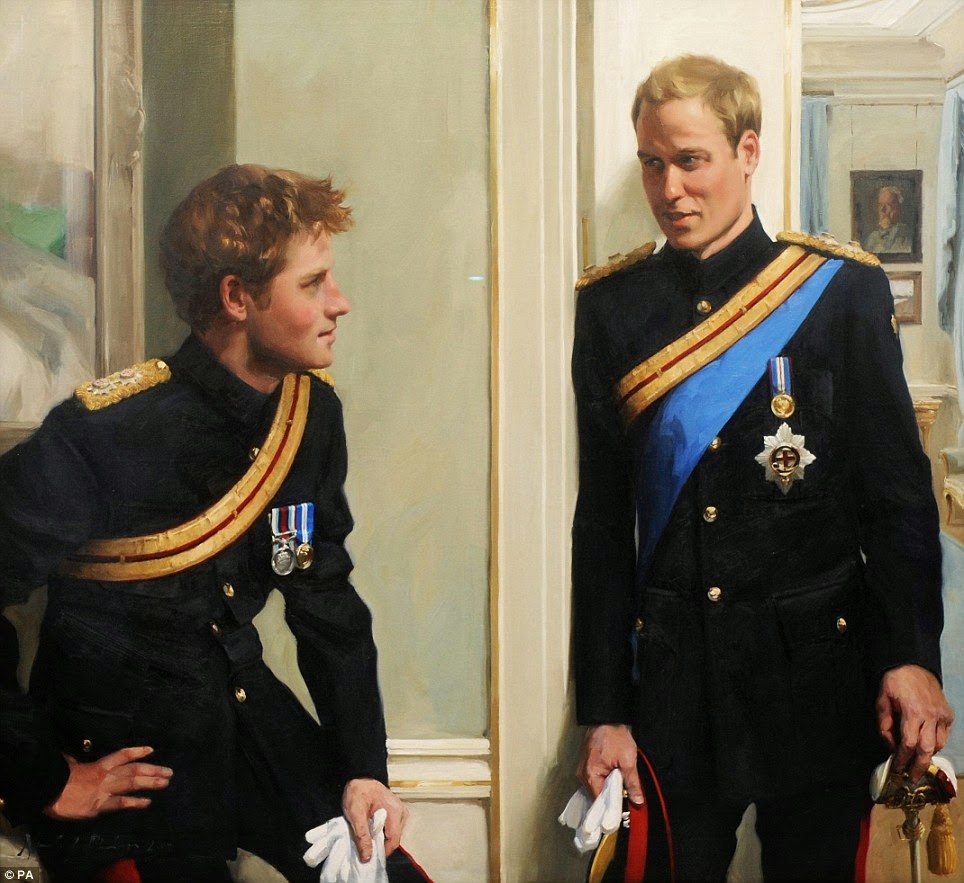
The National Portrait Gallery has another of  Nicky Philipps' paintings. There is a military connection between the two but the subjects are very different.  Prince William, then 27 and training to be an RAF search-and-rescue pilot, wears his dress uniform with the blue sash and star of the Order of the Garter, and the Queen''s Golden Jubilee medal. Harry, 25, also wears a Jubilee medal alongside his award for service in Afghanistn. It's a remarkable work, capturing an intimate  moment between two family members, modern young men  who are also being true to the tradition which comes from being a member of the Royal Family.

Incidentally, the painting of Simon Weston hangs next to a portrait of 'Kate Middleton', as she was described by the gallery staff member who pointed out the way. Like Simon another commoner, but this time one who has an intimate relationship with one of the princes - she is the Duchess of Cambridge, wife of Prince William and the mother of their baby son Prince George.
 
 MY LATEST BOOK: Things My Mothers Never Told Me  by Yvonne Craig Inskip, available on line as a paperback and an Ebook.
 
To read more about the paintings and the artist go to
www.bbc.co.uk/mediacentre/proginfo/2014/15/the-peoples-portrait.html 
 Search the NPG collection at www.npg.org.uk/collections.php 
  www.fineartcommissions.com/nicola-jane-philipps-(nicky).cfm
3/Historic-dual-portrait-Prince-William-Prince-Harry-unveiled-National-Portrait-Gallery.html#ixzz2y13Oqdxz 
http://www.dailymail.co.uk/news/article-12410  


Saturday, 29 March 2014

276. CIRCLES OF LIFE by MARTIN KRZYWINSKI


 Beautiful Science: Picturing Data, Inspiring Insight

British Library until  May 26th

 Circles of Life, 2013 © Martin Krzywinski

'I was frustrated', said Martin Krzywinski, 'reading a lot of the scientific papers and not understanding what they were saying. I just wanted them to be simpler. There’s nothing I can do to make biology simpler, but I started telling people to make clearer figures'. When the tools for gathering data had outpaced those for portraying it, he developed Circos, an open source visualization tool that arranges tabular data in circular form. It was a simple idea, but transformative.

 The British Library has set aside the Folio Gallery for a challenging and exquisitely beautiful exhibition of a journey from 17th century scientists' illustrated diagrams to up-to-the-minute interactive visualisations. Circles of Life illustrates the similarities between the human genome and those of other species, including chimpanzees and dogs. Each coloured square corresponds to a pair of chromosomes. Lines connect DNA sequences, visually depicting how much DNA we share with other species.


Recent years have unleashed a torrent of genetic data. Thousands of visualizations, with their distinctive aesthetic, celebrate the informational richness of our times.This may be, but there's a snag. The only one I could truly understand was a map of England showing the density of fast food outlets. The dark shaded-in areas were perhaps predictable but can you guess the areas which were almost blank? Cornwall and East Anglia. That I understand.


www.bl.uk/whatson/exhibitions/beautiful-science/ 
mkweb.bcgsc.ca
 
 Nicola Davis writes in The Observer: www.theguardian.com/technology/2014/feb/16/visualise-data-change-life-florence-nightingale


Follow @9brandon on Twitter.

Tuesday, 25 March 2014

275 SHELF WITH ANNIE FIGURINE by HAIM STEINBACH

ONCE AGAIN THE WORLD IS FLAT until 21 April 2014
Serpentine Gallery


Shelf with Annie Figurine, 1981, wood, 
plastic masks,plaster & paintphotographer (c) 2014 Hugh Grendinning


I came to the Serpentine Gallery after a glorious sunny  walk across three parks, through daffodils, crocuses, harebells and blossom with happy tourists speaking in many tongues, while squirrels, moorhens, ducks and geese noisily sorted out their domestic arrangements. And I found that Haim Steinbach's extraordinary talent has produced a show which is bracing and fun. 

Once Again The World Is Flat illustrates Steinbach's forty-year career, starting with his minimalist paintings of coloured bars placed round a monochrome square. These are  juxtaposed with sculpture, artefacts and children’s playthings: an Ajax can, a retro kettle, a plastic train engine. The  ordinary ( salt and pepper pots) as well as the extraordinary (a ceramic cookie jar shaped as a grinnng skull), are side by side. Some objects are hand made, some mass-produced, some old, some new. The artist questions 'high' versus 'low' culture, the unique versus the multiple, the personal versus the universal.

Shelf with Cookie Jar 1982. wood, paint, spray paint, shelf, plaster
The anthropologist Clyde Kluckhohn pointed out that each human being is simultaneously like some other human being, like all other people and like no other person. We each need a set of 'cultural glasses' which help us to perceive the world around us, interpret meanings and frame our actions. To do this we create classification systems for everything from foodstuffs to colours to diseases. The content varies from place to place and time to time but a system remains. This learned behaviour shapes our lives and our tastes. We have views, for example, on what is exotic and what is of value. Steinbach provokes us to think again.  Take the salt and pepper shakers which form a new work for the exhibition. Displayed in long rows, each pair has its own history and story, carrying a  meaning from a former context and, by being displayed, connecting  the private and the public sphere. Are they now 'put together in a way that is analogous to the arrangement of words in a poem, or to the musical notes in a score'? 

The Serpentine has also invited curators from a range of private and public institutions – including the Zabludowicz Collection and the V&A Museum of Childhood in London and Manchester’s Whitworth Art Gallery – to select works from their collections to be included in the exhibition.

www.serpentinegalleries.org/exhibitions-events/haim-steinbach-once-again-world-flat

whitecube.com/artists/haim_steinbach/ 
www.serpentinegalleries.org/exhibitions-events/exhibition 

Sunday, 23 March 2014

274 IF YOU BROKE ME by DAPHNE WRIGHT


 A SMALL THING TO ASK until April 25th at
FRITH STREET GALLERY (not in Frith Street but in Golden Square)

 If You Broke Me 2014 by Daphne Wright Photograph (c) the artist, Frith Street Gallery, 
This is a still from one of two short videos of the artist's sons. If you broke me and I am the beginning  each show a solitary boy speaking in riddles to the camera. Each  child’s face is painted, one as a tiger and the other with a beard.  Telling  a playground rhyme or puzzle is one moment when children have the upper hand. They know the punch line, the triumphant denouement, and the adults don't  - or pretend they don't.  But  Wright turns the game into an enigma.

Each boy's voice is soft, each boy's voice is monotonous. They stare back at us unblinking, heightening the tension. The fun, the mischief is draining away. The 'tiger' slowly asks us
'Will you still remember me in a day, will you still remember me in a week, a month' and so on. But there's no reassuring 'Yes!' to answer each question. When he gets to the climax 'Knock, Knock' we are dumb spectators. We can't say 'Who's there?' and so get a jokey reassuring answer. No body is there.  The child is talking to himself. He simply says 'You have forgotten me already'. The joke curdles into sorrow.


daphne wright kitchen table
Kitchen Table, 2014 by Daphne Wright Photograph (c) the artist, Frith Street Gallery,


Daphne Wright uses a wide range of materials: plaster, tinfoil, video, printmaking, found objects and performance.

In this sculpture two boys of life size are hanging around in the kitchen. Instead of the gentle colours of flesh and the signs of warmth and welcome we  want from a kitchen, everything is ashen and the restless energy of young people is turned into cold hard matter.

Is there is a hint of the  fairy tale of the Sleeping Beauty, tricked  by the spell of the Wicked Godmother? At the moment when her finger is pricked by a spinning wheel everyone is petrified, turned into stone wherever they are, whatever they are doing, and must keep that pose for a hundred years, until  released by a kiss. These boys are in the barest of kitchens slumped, bored, drooping. They look so lifelike but are simply not there. Are they waiting, like the boys in the video, for a  response which would bring laughter and warmth and a shared experience?
Laura Cumming in a brilliant review of the whole exhibition in the Guardian writes ' (Daphne Wright) creates worlds that are beautiful and rather eerie which feel like the threshold to somewhere new'.

www.theguardian.com/artanddesign/2014/mar/16/daphne-wright-frith-camille-henrot-chisenhale-review
www.frithstreetgallery.com/
frithstreetgallery.com/shows/view/daphne_wright_a_small_thing_to_ask/