Thursday, 9 August 2012

183. TROPHY by CONRAD SHAWCROSS


The moment you see The Trophy you are glad it is inside a glass case. It's a complex kinetic sculpture, bearing a passing resemblance to the pictures of the machine which was recently sent on a jaunt up to Mars to discover signs of life. This alarming robot is the goddess Diana who, in Titian's Diana and Acteon,  is distressed and vulnerable, having been spied upon by the unfortunate Acteon while bathing with her nymphs. In a later painting, The Death of Acteon, she exacts a terrible revenge: he is transformed into a stag, then torn to pieces by his own hounds. Here he is represented by a bare antler carved out of wood.

The light at the end of a probe is unnerving: it spirals and judders and swoops. At times 'Diana' seems to be preening and caressing herself, beguiling, almost flirtatious.Then the probe swings out towards Acteon, now  teasing and playful. But the mood changes. It becomes menacing and monstrous. Acteon cannot flinch or move. Then another switch - she seems content, as if conducting an impartial post mortem on her miserable victim.

I'm aware that attributing human motives to non humans is something I've tried to avoid all my life. But, as the person I was with said, 'robots are to art this year what 3D printing was to art in 2011'. You have to see to believe.

The centrepiece of the exhibition is a shadowy room which feels a bit like a corridor. It's hard to stay there with these three momentous Titians - Diana and Callisto, Diana and Acteon and The Death of Acteon. They need time and a good light but time is nibbled away by curiosity as to how three living artists have responded in the adjoining rooms. As well as Shawcross's Trophy, Chris Offilli's beautiful paintings in breathtaking colours transpose the classical world to Trinidad; and Mark Wallinger invites us to invade the goddess Diana's private space once again by peeping (one-eyed like the probe) into her bathroom.

Metamorphosis is a remarkable exhibition. A bit of a fairground. To celebrate the bringing together of these three Titian paintings, (two of which have been recently acquired), the help of not only artists but choreographers, composers, musicians, designers and poets has been called upon. We are invited to listen to poetry as well as inspect costumes, installations, set designs, paintings.

On the way out is the small gallery cinema showing clips from the ballets and a number of poets reading their specially commissioned work. (Patience Agabi, Christopher Reid, Seamus Heaney and Sinead Morrissey are the poets who get my vote). You can buy a beautifully illustrated book of the poems together with an essay on Ovid, Titian and English Poetry, and images of all three  Titian paintings. 
Metamorphosis: poems inspired by Titian, published by The National Gallery, only £8.

You can also get a stunning image of Trophy, of the Titian paintings, and much much more if you follow the links on     nationalgallery.org.uk


Saturday, 4 August 2012

182. BRADLEY WIGGINS GOLD by RICHARD WENTWORTH


Thanks to the Guardian series Olympics on Art  for this picture

Richard Wentworth gave up making sculpture for a while in the 1970s, thinking it had become 'as dry as broken biscuits'. Fortunately he changed his mind. This is the man who reminds us that an object has a beginning a middle and an end . You select it, use it - and walk away. Closure. But a work of art is unfathomable and you can interact with it forever. He takes the hundrum, the quotidian,and makes us think again. At a Tate study day he casually observed ' a plate is the only object where you get your own and the minute you have finished with it, it becomes someone else's' You can see a couple of examples of his witty and refreshing sculptures in Blog 77.

Recently he was on a camping holiday  - a habit of 30 years - and he took this photograph. My experience is that camping draws you into an intimate world where warmth and water, toilet blocks and torches become as life-enhancing as birdsong and sunsets and dew on the grass... Meanwhile world events happen on another planet. 

He was invited by friends to watch some Olympics. 'Catching sight of television in bars is the kind of glimpsing I enjoy – images, languages and 'events' all arbitrarily associated with time and displacement...The latch on this door will remind me of the warm domestic afternoon in early August 2012 when our friends invited us to watch London as a site of Olympic spectacle. An odd thing if you know the city well, but much stranger if you are camping a long way away.'

The photo is a tease. You want to rest your eye on the star, the scarlet-clad genius known as Bradley Wiggins, a man in a million, who may vanish from sight in a few precious seconds. But the  latch and the overbearing nails are closer and more familiar. I watched the Olympic opening ceremony at a party with friends and family. The amazing spectacle was accompanied by a domestic soundtrack of explosive remarks, laughter, whooshes of appreciation, scraps of music identified by the cognoscenti, apologies for tears...I cannot think of one without the other.

richardwentworth.com    for a large selection of images of his work


Monday, 30 July 2012

181. WORK No 1197 by MARTIN CREED

On the left is the man who got tens of thousands of us up early on July 27 so that at 8.12am precisely we would stand on street corners or in parks or in our own homes to ring any bell we could lay our hands on. Why? To signal the start of the London Olympics and welcome the 209 competing nations. We used hand bells and church bells and bicycle bells; triangles; castanets; drums; tambourines... For a solid 3 minutes we made as much noise as possible. Passing cars, including police vehicles, blared their horns, pedestrians waved. The crowd above, in Kennington, were near enough to hear Big Ben, the clock of the Palace of Westminster, break all the rules and chime more than 40 times during those precious minutes.


..It was all the idea of Martin Creed, the artist who caused such consternation when he won the Turner Prize in 2001 with The Lights Going On and Off - a empty room with the lights doing just that every few seconds. Perhaps it's his Quaker background which leads him to apply simple rules, sometimes only using paint brushes in a multi pack or making one mark a day with the same felt-tip pen until the surface is covered. He's one of a number of artists commissioned to design an Olympic poster, seen here.  This is Work No 1273, made from 5 single brush strokes derived from the Olympic colours. It represents an extended podium with steps offering places beyond first, second and third, paying tribute to  the excellence of all the competing Olympic sportswomen and sportsmen.


Sunday, 29 July 2012

180 HOLLOW/STUFFED, MARKET LAW by DAMIAN ORTEGA

c Damian Ortego;Photo Todd-White Art; courtesy White Cube
On the lower ground floor of the White Cube Gallery in Mason's Yard a submarine (198 x 87 x 874cm) floats from the ceiling. It's based on a plastic model of a WW2 GermanType XXI submarine and is made of biodegradable plastic sacks, metal - and salt. So instead of seeing something aggressive and agile like a real submarine, all you get is a rather sad, flaccid, immobile vessel, incontinent too in that it can't even protect its own contents.A thin white line of salt is the only moving part and it drools onto the floor below, piling up in a heap. Look long enough and you spot minute folds and hollows in the mould's geometrical perfection. The grains do not move individually over the surface but slide down like slow  tears.

Salt is usually our ally, a preservative and flavouring agent which can be used as currency in exchange for other desirable goods. The notes you can ask for at the reception desk tell me Ortego is using it as a metaphor for exploring human intervention.This piece refers to the illicit use of submarines carrying another white substance, cocaine, along the South American coast to Mexico.

The notes also tell me that the title refers to T.S.Eliot's poem The Hollow Men, which, we are told, is a reference to Joseph Conrad's novel The Heart of Darkness.
'We are the hollow men
We are the stuffed men'
is how the poem begins but it is probably better known for its final lines:
'This is the way the world ends
Not with a bang but a whimper.'
On the ground floor a thin line of salt is etched onto car tyres piled in a heap on the gallery floor. The title Congo River relates again to Conrad's novel and to the epic film Apocalypse Now, both of which use a river journey to examine the unknown.
I confess I have difficulty in relating to art works which need so much explanatory text. No, that's not true. I think of times when the text is part of the artwork, as in Michael Craig-Martin's famous Oak Tree 1973, when he exhibited a glass of water on a glass shelf announcing that it was in fact an oak tree - and gave cogent reasons why we should believe him. But to have the artist's intentions not even in the same gallery room is hard. I know there are substantial arguments against  heavy labelling which might prejudice what the viewer sees, but I think the present arrangement does little to enhace the viewing experience. Indeed I felt infantalised, asking for a crib sheet.

However, Ortego is an artist who playfully and artfully makes you look again. He uses surprising objects - from golf balls to pick axes to bricks, rubbish bins and torilla - to create inspirational art, all subject to what has been described as Ortego's 'characteristically mischievous process of transformation and dysfunction'. Here is Cosmic Thing, a 1989 Volkswagen Beetle car as you have never seen it, shown at the Venice Biennale in 2003. The Boston Globe called it 'a car manual brought to life'.
White Cube is the London gallery which continues to show this innovative Mexican artist.

http://whitecube.com/artists/damin_ortega
www.youtube.com/watch?v=Ts4CO79Y-ls   this is a link with a very good commentary on Cosmic Thing when shown at ICA Boston

Tuesday, 24 July 2012

179. POND by GEOFF ROUTH

Long and Ryle Gallery, 4 Islip Street, SW1P 4PX

None of the images I put in the screen in my blog do justice to the work, but this time in particular it's hard to capture Routh's crisp, sensitive painting, and so feel the squelchy, blurred  water-edges where nature takes over the man-made architectural features of the garden. The Annie McCall Hospital was built at Stockwell, South London in 1915, as one of the first specialised maternity units in Europe. Its life came to an end in the 1970s and the handsome building and grounds fell into decay until 1987 when artists and musicians transformed the wards into studios.

For the past 25 years Geoff Routh has been painting a visual biography of the building and its grounds: weeds edging through cracks in the windows, ivy fighting to get to the light; moss on the brick walls by the drain pipe. They are paintings of fact, observation and record. Their dense surfaces are alive with passionate description. It's hard to put into words. But look at the water in the picture above. Joss Muir, from Class 2 in Stromness Primary School in the Orkneys  was looking at a painting by Margaret Mellis. I like the way he describes what he saw: 'the blue bit is like water hanging down'.

longandryle.com
 The Guardian 13 February 2012 has an article by Peter Walker on the controversial future of the site which is likely to be developed for housing
If you search for Geoff Routh, you'll find a number of snatches of video and text about his work.

Wednesday, 18 July 2012

178. LITTLE SUN by OLAFUR ELIASSON

LITTLE SUN  at TATE MODERN
It's a solar-powered lamp, the latest work of Olafur Eliasson, the artist whose work The Weather Project 2003 attracted 2 million of us to Tate Modern. There his huge blowsy sun, with mist and mirrors on the ceiling, transformed the massive Turbine Hall into an unlikely playground.

Little Sun is his latest work. Again he uses light and again engages the viewer, but this time for a serious purpose. Little Sun was developed with Frederik Ottesen. It works like this: expose the solar panel at the back to the sun for 5 hours, turn it over and you have stored 5 hours of strong light for the evening. It could replace kerosene lamps: it's estimated that over 3 years a family can save over 90% of what it usually spends on energy for lighting, at the same time getting ten times more and better light. And kerosene is a health hazard: did you know that a ten year old girl doing her homework in the light of a wick-based lamp breathes in pollution the equivalent of 40 cigarettes a day? Then add the constant risk of kerosene spills in homes made of flammable materials.
 
So Little Sun could change people's lives. Quite a lot of people, if you consider that one person in five on this planet (1.6 billion)  lives without access to mains electricity.

But is it art? Can art have an instrumental value? Why not market it through Ikea, rather than the London Cultural Olympiad and Tate Modern?  Eliasson is an artist who invites us to look again at our world and our taken-for-granted assumptions, and to question what it means to live on our planet today. In Eliasson's words,  'Little Sun transforms the light that is for all of us into light that is for each of us'.

In 2010 Neil McGregor, the Director of the British Museum, produced a book and a hugely successful series of broadcasts on The History of the World in 100 Objects. What did he choose for his one hundredth significant object? A solar power lamp and charger.

Four Tate Blackouts are taking place on Saturday nights between 10pm and midnight, starting on July 28th. The lights will go out but visitors can view the Surrealist works in a suite of galleries. Entry is free but you will need to buy a Little Sun (£16.50 or 22 Euros). It's an echo of a 1938 Surrealist Exhibition in Paris  where Man Ray supplied visitors with torches to explore the galleries.

Charlotte Higgins gives a full account in:
guardian.co.uk/artanddesign/2012/jul/12/olafur-eliasson

Monday, 16 July 2012

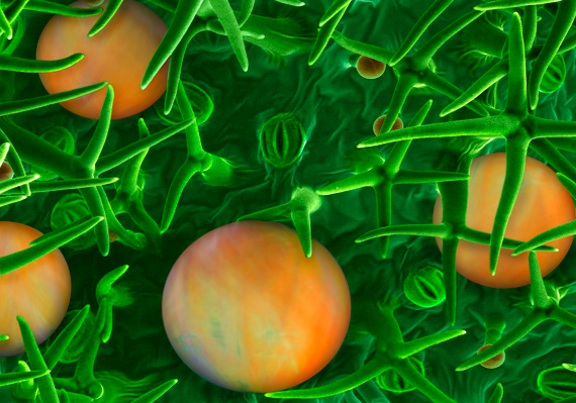
177. LAVENDER LEAF by ANNIE CAVANAGH & DAVID MCCARTHY

Wellcome Image Awards         Pictures copyright: Annie Cavanagh and David Mccarthy

.At first glance could these be  abstract paintings? The one on the right is perhaps slightly unsettling:  those golden globes  are neither completely embedded in the green spikes, nor are they nestling on the top.  And the spikes themselves look like barbed wire covered in Fuzzy Felt

In fact what the Wellcome is showing us is work done by medical researchers. 'Scientific images often reveal a world hidden to our normal sense of vision.  They are not merely tools for research but  are capable of inspiring people and sparking their curiosity', writes Dr Mark Petronczki of Cancer Research UK.  Could it also be said that this is the latest, the very latest, expression of  an art genre beloved for centuries in this country and in Europe: detailed, technically accurate,  exquisite drawings and paintings, especially watercolours, of flowers and living plants.
This false-coloured scanning electron micrograph (SEM) shows on the right the surface of a lavender leaf, imaged at 200 microns, covered with fine hair-like outgrowths made from specialised cells. These outgrowths keep frost at bay, make sure that pests are unwelcome,  and break up the air flow to reduce evaporation. From the orange globes, lavender yields a sweet oil widely used in balms, salves, perfumes, and cosmetics. It's also believed to aid relaxation and sleep, and  to calm the anxious.

The beautiful explosion on the left is nothing less than a loperamide crystal.  Loperamide is an antimotility drug, well known as a very good friend to anyone stricken with diarrhoea. Among other properties it also acts like blessed morphia, lessening the pain by decreasing muscle tone. The crystal group - seen as never before - measures approximately 250 microns across.

The light boxes displaying the images are in a small black gallery at the Wellcome, quiet as a chapel (if you are alone). If you can't get there, I suggest you browse the gallery on